CALPHAD 89 (2025) 102825 · Jindal & Lele

Research Highlight

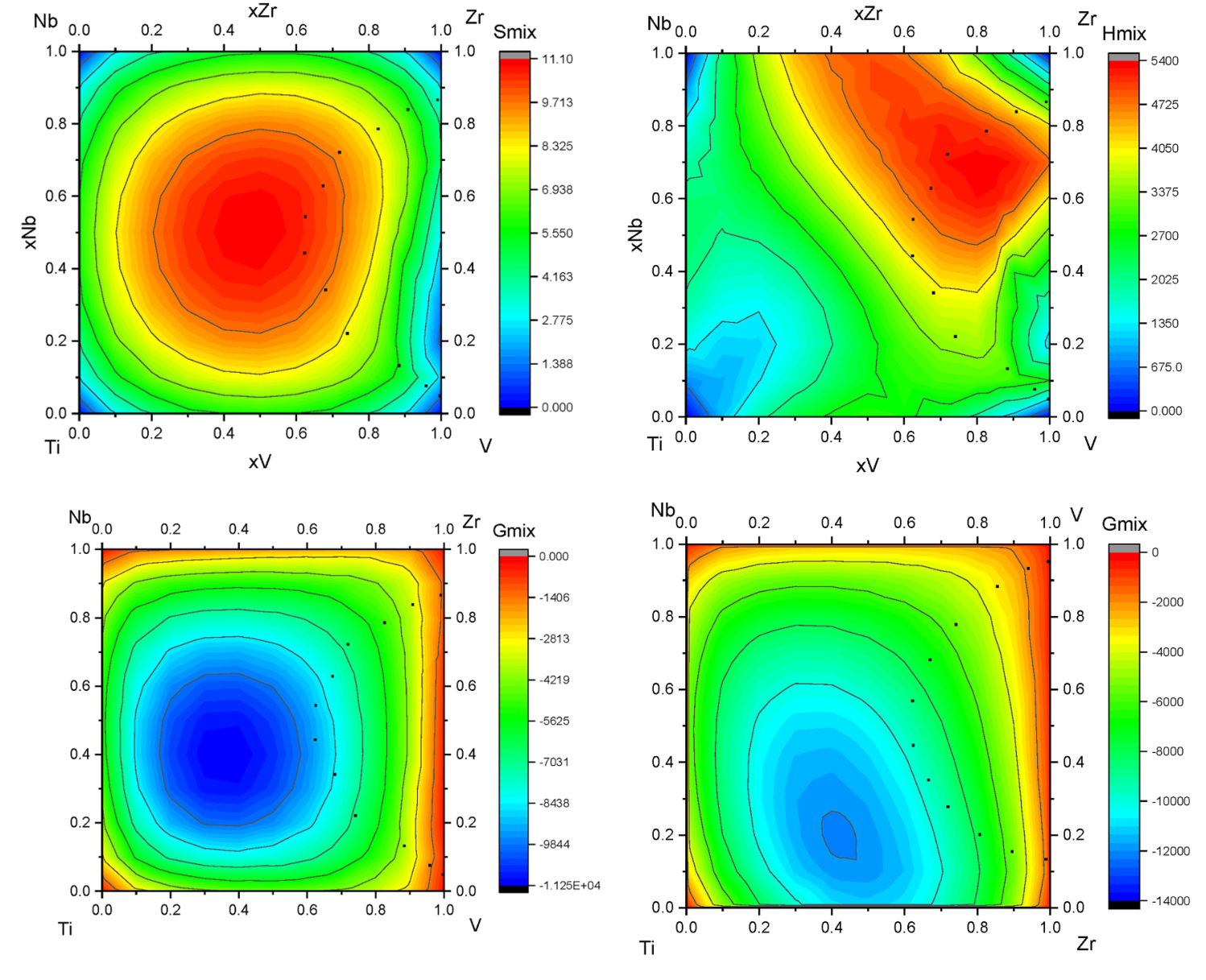
Contour plots of configurational entropy, enthalpy and Gibbs energy of mixing for the Nb-Ti-V-Zr high entropy alloy system

Fig. 20. Contour plots of configurational entropy (a), enthalpy (b), and Gibbs energy of mixing (c) at 1273K for the Nb-Ti-V-Zr high entropy alloy system. Dotted lines mark the miscibility gap boundary.

Multicomponent Cluster Variation Method: Application to High Entropy Alloys

V. Jindal & S. Lele · Calphad 89 (2025) 102825

A new thermodynamic framework is introduced for extending cluster expansion methods to multicomponent alloys. Unlike existing approaches, the cluster expansion coefficients of binary and ternary subsystems can be directly inherited into higher-order systems — enabling self-consistent databases analogous to CALPHAD.

Applied to the Nb-Ti-V-Zr refractory high entropy alloy system, the model reveals that both entropy and enthalpy play significant roles in stabilising the single-phase bcc region. Titanium addition is shown to suppress the strong phase-separation tendency of Nb-V-Zr alloys — a key insight for computational design of stable HEAs.

  • First framework where binary/ternary thermodynamic parameters inherit directly into multicomponent databases
  • Number of parameters does not grow exponentially with number of components
  • Entropy and enthalpy both drive bcc stabilisation in Nb-Ti-V-Zr HEAs
  • Short-range ordering predicts V-rich and Zr-rich clustering — useful for alloy design
Read full paper ↗ View research poster →

The Materials Modeling Lab (MML) is part of the Department of Metallurgical Engineering at IIT (BHU), Varanasi. We develop next-generation computational and experimental tools for designing advanced materials — from high-entropy alloys and Ti-TiB composites to beta-titanium biomedical implants and functionally graded armour materials.

Our work bridges classical thermodynamic modelling (CALPHAD, CVM, CE) with modern machine learning and atomistic simulations, placing us at the intersection of traditional materials science and data-driven discovery.

Research Focus

Computational Thermodynamics

CALPHAD, Cluster Variation Method (CVM), and Cluster Expansion (CE) for phase diagram assessment and Gibbs energy modelling.

High Entropy Alloys

Thermodynamic modelling of short-range ordering, neural-network-driven enthalpy prediction, and experimental validation of HEAs.

🧠

Machine Learning in Materials

ML + DFT for hardness prediction in refractory HEAs, neural network models for SRO, and data-driven alloy design pipelines.

Ti-TiB Composites & FGMs

CALPHAD-guided processing of Ti-TiB composites and Functionally Graded Armour Materials for defence and biomedical applications.

Beta-Ti Biomedical Alloys

Low-modulus beta-titanium alloys for dental and orthopaedic implants — thermodynamic design and experimental characterisation.

Atomistic Simulations

MD and MC simulations for phase transitions, dislocation evolution, and alloy thermodynamics at the atomic scale.

Join the MML Group

We are seeking motivated PhD students, M.Tech project students, and post-doctoral researchers with a passion for computational materials science and data-driven design.

View Openings Contact Us

Our Sponsors & Partners

IIT (BHU) Logo SERB Logo DRDO Logo IIT Logo

Funded by IIT(BHU), SERB (CRG), DRDO–ARMREB, SRTMI–SAIL, and IIT(BHU) Challenge Grant